
consumer education
Ingredient Checker App: Decode Food Labels in Seconds

An ingredient checker app scans a product's barcode and instantly translates its ingredient list into plain language. It flags additives with safety concerns, explains what each ingredient does, and scores the overall product. Independent apps like ScanVeer rate food, cosmetics, and supplements on a 0-100 scale using published evidence, not brand payments.
The short version
- Scan the product's barcode with your checker app before the marketing on the front of the pack influences you.
- Read the overall 0-100 score to get a quick, comparable verdict.
- Open the ingredient breakdown and look for any flagged additives.
- Tap each flag to see why it exists — the evidence matters more than the warning itself.
- Check the suggested swaps and pick one better-rated alternative in the same category.
Key takeaways
- Ingredient lists are ordered by weight, so the first three ingredients tell you most of what you need to know.
- A chemical-sounding name is not proof of harm — ascorbic acid is just vitamin C, while "natural flavors" can hide dozens of compounds.
- A few additives, like titanium dioxide and sodium nitrite, have genuine evidence behind the caution; most are routine and well studied.
- An ingredient checker app is only as good as its data source and its independence from brand money.
- Use scores to compare within a category and make one better swap per shopping trip rather than chasing a perfect cart.
In this article
Why Food Labels Are So Hard to Read
Flip over almost any packaged food and you meet a wall of small print: maltodextrin, cellulose gum, mixed tocopherols, Red 40. Most shoppers give up within seconds — and an ingredient checker app exists precisely to close that gap, translating the fine print while you are still standing in the aisle.
Labels follow rules, but the rules leave room to obscure. Three patterns cause most of the confusion:
- Order by weight. Ingredients are listed from most to least. If sugar appears first or second, that tells you more than any front-of-pack claim.
- Split naming. Sugar can appear as cane juice, dextrose, rice syrup, and fruit concentrate — four entries that would sit higher on the list combined.
- Umbrella terms. "Natural flavors" and "spices" are legal catch-alls that can cover dozens of undisclosed compounds.
Add serving sizes that shrink to make sodium or added sugar look modest, and it becomes clear the label is technically accurate but practically hard to use. The FDA's overview of food ingredients and colors explains what each additive category does — useful background, but not something anyone reads mid-shop. That is the job a scanner does for you.
Additives Worth Watching (and Ones That Are Fine)
Here is the honest version: most additives are boring. Preservatives, emulsifiers, and acidity regulators are heavily studied, used in tiny amounts, and generally recognized as safe. A chemical-sounding name is not evidence of harm — ascorbic acid is simply vitamin C.
A shorter list genuinely deserves attention, and it helps to know where the evidence is established versus still emerging:
| Additive | Common role | What the evidence says |
|---|---|---|
| Sodium nitrite | Cures processed meat | Processed meat is classified as carcinogenic to humans by the WHO's cancer agency — established evidence; moderation is the practical takeaway. |
| Titanium dioxide | Whitening agent | Banned in EU foods since 2022 over unresolved genotoxicity questions; still permitted in the US. |
| BHA / BHT | Preservative | BHA is "reasonably anticipated" to be a carcinogen at high doses in US toxicology reports; human data at food levels is limited. |
| Carrageenan | Thickener | Emerging research on gut irritation; major regulators still consider it safe. |
| Ascorbic acid | Antioxidant | Vitamin C. No concern — a reminder that names can mislead in both directions. |
The bigger, better-supported pattern is degree of processing: Harvard's Nutrition Source links diets heavy in ultra-processed foods to worse health outcomes overall. One flagged additive matters less than a cart full of ultra-processed products.
How an Ingredient Checker App Decodes a Label
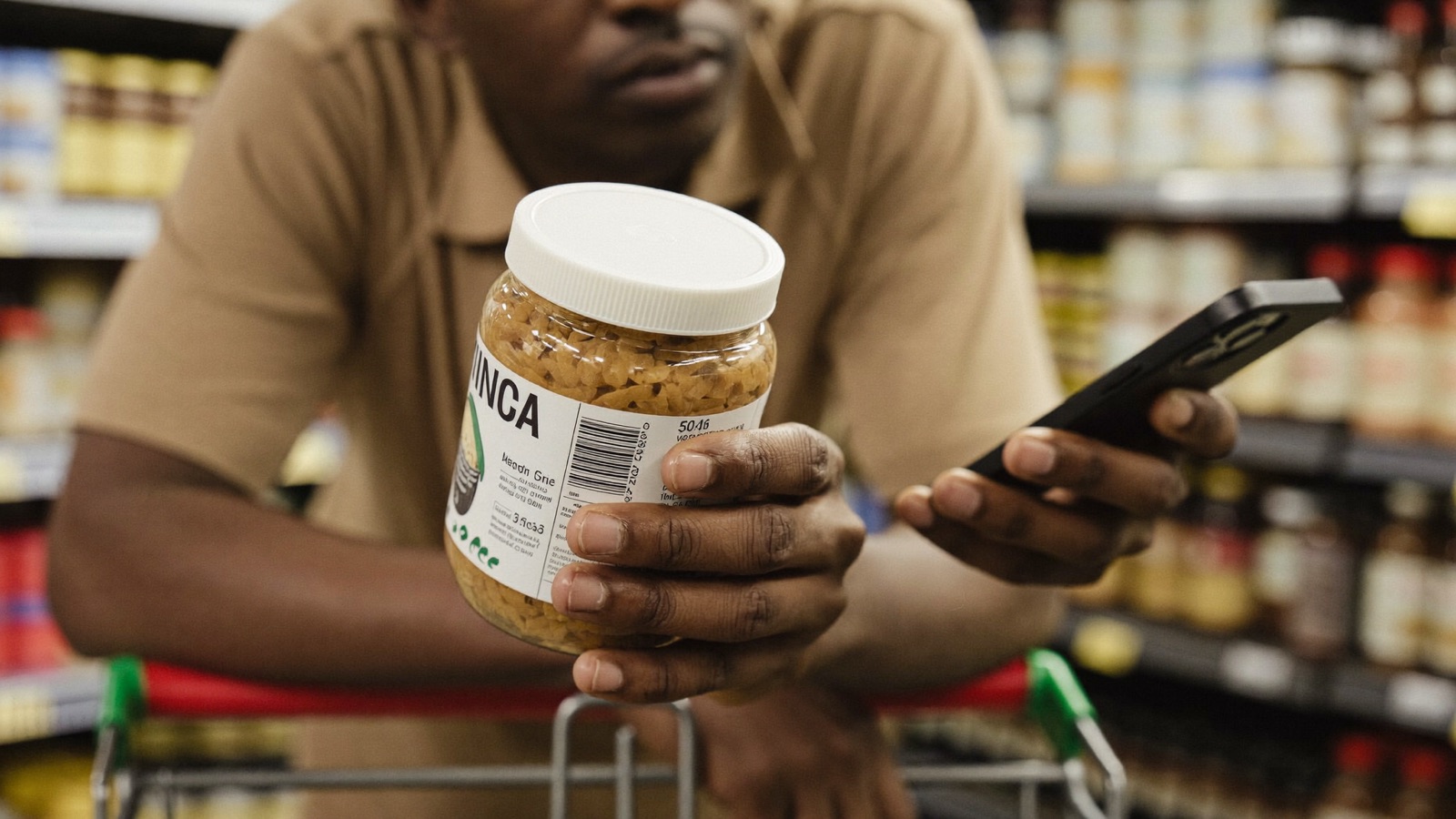
When you scan a barcode, a good ingredient checker app does four things in about a second: it matches the code against a product database, parses the ingredient list, checks each ingredient against published safety evidence, and rolls everything into a single comparable score.
The data behind the scan
Most apps build on open databases like Open Food Facts, a crowdsourced catalog of millions of products. Crowdsourced data is powerful but imperfect — labels get reformulated and entries go stale — which is why verification matters as much as coverage. We explain how ScanVeer cross-checks entries in our guide to how food scanner verification works.
The scoring layer
This is where apps differ most. Some weight additives heavily; others emphasize nutrition. ScanVeer scores food, cosmetics, and supplements on a 0-100 scale, separates established evidence from emerging research in every flag, and publishes the full methodology at scanveer.com/how-we-score. Whatever app you choose, ask two questions: can you see why a product scored what it did, and does the company take money from the brands it rates? If the answer to the second is yes, the score is marketing.

Scan Smarter With ScanVeer
You do not need to memorize additive names or decode E-numbers in the aisle. Point your camera at the barcode and ScanVeer gives you a 0-100 score, a plain-language breakdown of every ingredient, and better-rated swaps in the same category — free, for food, cosmetics, and supplements alike.
What makes it different is independence. ScanVeer takes no brand payments and sells no placement, so a 34 stays a 34 no matter who made the product. Every flag links to its evidence, clearly labeled as established or emerging, and the methodology is public.
Start small: scan the five products you buy most often. Keep the ones that score well, swap one that does not, and repeat next trip. Label literacy compounds quickly once the fine print is translated for you. For a deeper look at choosing and using a scanner, see our 2026 guide to food health scanner apps.
Scan it before you buy it
ScanVeer gives any food, cosmetic, or supplement an instant 0–100 health score from unbiased data. Free and independent — brands can't pay for scores, ever.
Download ScanVeer freeFrequently asked questions
What is the best free ingredient checker app?
Look for three things: broad coverage (food, cosmetics, and supplements), a published scoring methodology, and independence from brand money. ScanVeer meets all three — it is free, scores products 0-100 using published evidence, and publishes its full methodology openly, so you can verify how every score is built rather than taking it on faith.
How do I check if a food additive is safe?
Check what major regulators and research bodies say rather than headlines. The FDA and EFSA publish additive evaluations, and an evidence-based scanner app summarizes them per ingredient. Crucially, distinguish established findings, like the processed-meat classification, from emerging research, like carrageenan and gut irritation, which is suggestive but not settled.
Does an ingredient checker app work on cosmetics and supplements?
Most food scanners stop at food, which is a real limitation since ingredient concerns also apply to skincare and supplements. ScanVeer covers all three product types with one scan. For supplements specifically, labels have their own traps — proprietary blends and fillers — covered in our guide to reading supplement labels.
Are E-numbers and chemical-sounding ingredients bad for you?
No — an E-number is just a European code, and many cover harmless substances like E300, which is vitamin C. A long chemical name tells you nothing about safety by itself. What matters is the specific ingredient's evidence base and the overall degree of processing, which is exactly what a scanner app evaluates for you.
Can I trust the health score an ingredient scanner gives me?
Trust scores you can audit. A trustworthy app shows why a product scored what it did, cites evidence for each flag, and takes no money from the brands it rates — otherwise the score is effectively advertising. ScanVeer publishes its methodology at scanveer.com/how-we-score, and scores are best used to compare products within the same category.